

A Plant Care Guide That
Starts at the Roots
The care a plant needs was decided long before it reached Baltimore, in the desert or rain forest it calls home. These guides start there.
Where it grew up shapes how you care for it
A succulent that survived the Sahara and a fern raised on a forest floor are asking you for two different lives.
Quincy Goldsmith, our founder, is a metallurgical engineer as well as a shopkeeper, and the shop wears that training openly. Plants in our Charles Street shop are shelved by origin, Africa, Asia, the Americas, and Australia, and the guides follow the same shelving. Ask where yours is from and you'll get the story too.
Houseplant care by origin starts with the map, so each guide walks the continent’s landscapes, the trivia that survives a dinner party, and the houseplants that trace their roots there, with honest notes on how hard each one is to keep happy.

Pick a continent, meet your plants
Four regions, four guides, each pairing the geography with the houseplants it gave us.

Africa
Snake plant, fiddle leaf fig, and dragon tree, from arid West Africa, its lowland rain forests, and Madagascar.
Read the Africa guide 02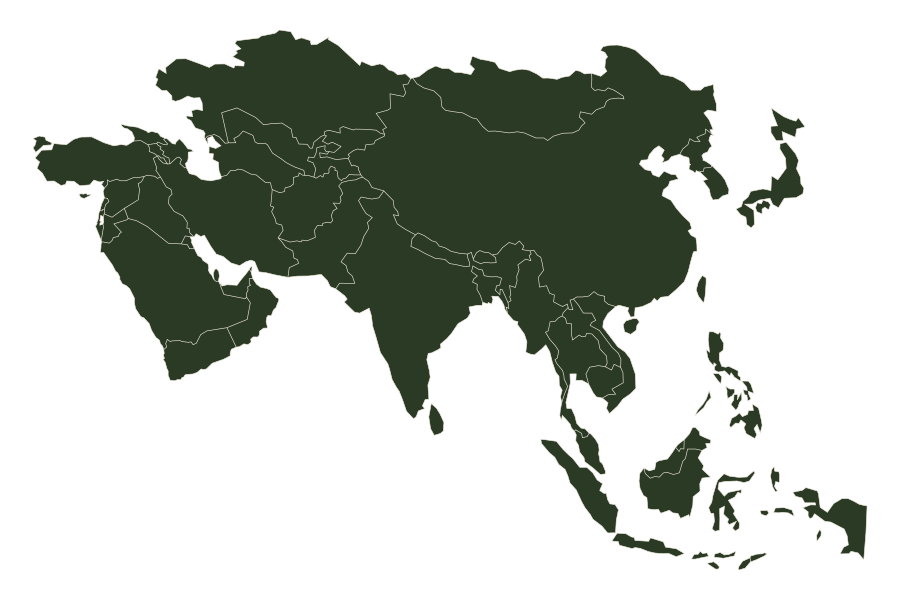
Asia
Hoya, ficus Audrey, and black velvet alocasia, out of the continent botanists call the Mother of Gardens.
Read the Asia guide 03
The Americas
Monstera, philodendron, and peperomia, raised in the rain forests of Central America, the Caribbean, and South America.
Read the Americas guide 04
Australia
Umbrella tree, weeping fig, and Kimberley queen fern, shaped by the most isolated continent on Earth.
Read the Australia guideLearn where a plant comes from.
The rest of its care starts to make sense.
Start with one plant: hoya kerrii
Sometimes you don’t need a continent, you need help with the one plant sitting on your windowsill.
Our deepest single plant guide covers hoya kerrii, the heart shaped sweetheart vine that shows up everywhere around Valentine’s Day. Light, water, humidity, feeding, and soil, all in one place, so those thick little hearts keep their plump good looks year round.

Bring us your plant questions
A written guide only takes you so far. After that, come talk to us.
The advice is free with every visit. Bring a photo of the leaf that’s browning or the vine that stopped vining, and we’ll figure it out together at the shop on Charles Street, downtown Baltimore.

Plant care questions we hear most
How often should I water my houseplants?
Watering runs on the plant, not on a day of the week, and that’s the whole point of caring by origin. A succulent from arid Africa wants its soil bone dry between drinks, while a fern from a rain forest floor wants steady moisture. Check the soil with your finger before you water, and let the plant’s home region set the rhythm. To water your plants well, soak the soil until the extra drains out of the drainage holes, then empty the saucer. Most indoor plants grow slowly in the winter months and need less.
What does bright indirect light mean?
Bright indirect light is a spot near a window where the plant sees plenty of daylight but the sun’s rays never land directly on the leaves for long stretches. A few feet back from a south or west facing window, or right in an east facing one, usually gets you there. Most tropical plants like bright light of that kind, while direct sunlight through glass can scorch their leaves.
Can I bring plant questions into the shop?
Please do. Plants, accessories, and knowledge are what we trade in, and the questions are often the best part of the visit. Bring a photo of the plant you’re wondering about and we’ll talk it through.
Which plants handle low light?
Snake plants and ZZ plants are the classic low light plants, and they forgive a dim corner better than most. A spider plant sits in the middle: happiest in bright indirect light, but forgiving of a shadier shelf. Even low light means daylight you could read by, since no plant lives in the dark.
What is root rot, and how do I avoid it?
Root rot happens when plant roots sit in soggy soil and run short of air. Check the soil before you water, use a pot with drainage holes, and let the top inch or two dry out for most houseplants. Dark, mushy roots and a sour smell mean the soil has stayed wet too long.
What should I do about pests on a houseplant?
Pests on a houseplant are easiest to handle early. Move the plant away from the others, wipe the leaves, and treat with insecticidal soap or neem oil, following the label. Check the undersides of the leaves, where spider mites and other pests like to hide.
Do houseplants need fertilizer?
Houseplants need fertilizer only while they’re actively growing. Plants grow most when the days are long and the light is bright, so feed lightly then; a slow release fertilizer is an easy way to do it. Skip feeding when growth stops.
What care tips help a new plant parent?
The best care tips for a new plant parent are small ones. Start with a forgiving plant, learn its home region, and water only when the soil says it’s time. Keep the routine steady, since plants like the same window week to week, and put light first, because plants need it before water or food.
Questions grow better in person
Come meet the plants, ask about the one you already have at home, and stay a while. If a gathering is on your mind, the Stem Room, the courtyard, and the Gallery are here to see too.
Prefer to leave a voicemail? (410) 429-7095
Stay up to date on all the happenings
Stem & Vine hosts a variety of events, from private bookings to community nights where the public is welcome.
We never sell your information, and you can leave the list any time.